
The Steadfast Servant
William J. Garvelink’s life was proof that America’s power is measured not in armies, but in the lives it saves.

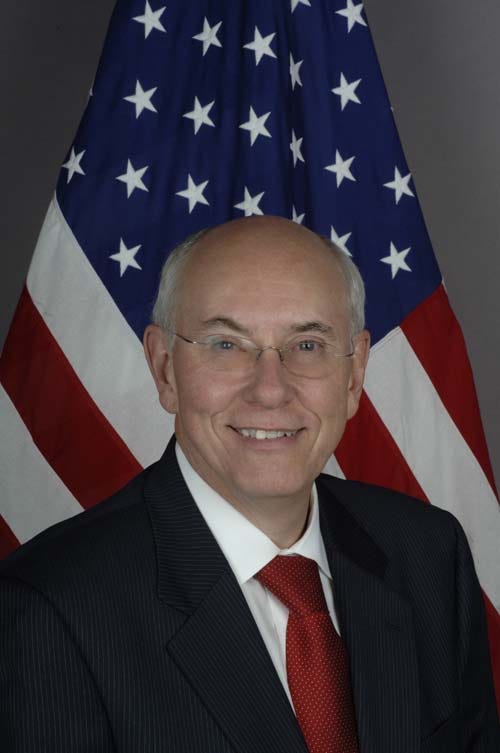
The USAID family has lost one of its own. For more than three decades, Amb. Bill Garvelink embodied the agency’s highest calling — to show up in the world’s darkest hours with courage, compassion, and resolve. His death is a wound for those who served beside him and for the countless communities his work helped sustain.
William John Garvelink (1949–2025)
On August 20, 2025, the United States lost one of its most steadfast servants. William John “Bill” Garvelink, a career diplomat and humanitarian who carried American values into the hardest corners of the world, died at 76. He leaves behind his wife of 55 years, a partner in every sense of the word, and a family that bore the cost and pride of a life lived in service. His passing is not only a personal loss for them but a loss for America, for USAID, and for all who believe in the work of dignity, democracy, and compassion.
Born in Holland, Michigan, on May 22, 1949, Garvelink grew up in a Dutch-American community that shaped his sense of duty and belonging. After earning degrees from Calvin College and the University of Minnesota, and pursuing doctoral work at the University of North Carolina, he arrived in Washington in 1976 to serve on Congressman Don Fraser’s staff. At a time when human rights barely had a foothold in U.S. foreign policy, Garvelink was one of only two specialists on Capitol Hill. He worked alongside Senator Hubert Humphrey and Senator Edward Kennedy, men whose names define chapters of American history, and from those years he carried forward a conviction that the power of government must bend toward justice.
Garvelink joined USAID in 1979, beginning a three-decade career in which he responded to famine, war, and disaster across five continents. In the Office of Foreign Disaster Assistance, where he served more than a decade and rose to deputy director, he helped shape U.S. responses to some of the world’s darkest hours. He led Disaster Assistance Response Teams in Somalia during famine, in Rwanda during genocide, and chaired U.S. task forces after the Indian Ocean tsunami. In 1989, with Julia Taft, he helped launch Operation Lifeline Sudan, an unprecedented effort to deliver food across battle lines to starving civilians.
“It was unprecedented. We broke through war lines because people were starving. That was the only calculation that mattered.”
— William J. Garvelink on Operation Lifeline Sudan
That mission saved countless lives and became a model for how America could act not with bombs or threats but with bread and stubborn humanity. He was remembered by colleagues as the man who made the impossible move, the problem-solver when disaster struck.
In 2007, President George W. Bush appointed him U.S. Ambassador to the Democratic Republic of the Congo. He arrived in Kinshasa at a fragile moment in that nation’s history. Garvelink worked to stabilize a country scarred by years of conflict, pressing for reforms, supporting food security, and coordinating aid that reached people long failed by their own leaders. He understood that democracy in Congo was not an abstraction but the difference between survival and collapse. Those who watched him at work saw not a careerist, but a steady presence, empathetic in action as well as word, who believed America had a duty to walk beside the people of Congo as they rebuilt.
After his ambassadorship, he turned to one of the defining issues of our century: hunger. In 2010 he helped lead the Obama administration’s Feed the Future initiative, a $3.5 billion global program to strengthen agriculture and nutrition. He became the first head of USAID’s Bureau for Food Security, carrying his practical wisdom from refugee camps into global policy.
“Food security is not charity. It is the foundation of stability, dignity, and peace.”
— William J. Garvelink, launching Feed the Future
Later, he advised International Medical Corps, the same organization that had stood with him in Rwanda, Somalia, and beyond. Even in retirement, he never stepped away. He remained, until the end, faithful to the conviction that America’s strength lay in feeding the hungry, healing the sick, and defending the vulnerable.
Garvelink received many awards, including the Presidential Meritorious Service Award. Yet his true honor is written in the lives he touched, the refugees who ate because a convoy arrived, the soldiers in Kisangani trained to serve a people and not just a regime, the millions lifted by food security programs he helped shape. To his family and his colleagues, he was more than his résumé. He was steady. He was principled. He never mistook power for purpose.
Bill Garvelink’s life reminds us that America’s greatness is not in its wealth, not in its armies, but in its ability to care, to act, and to keep faith with the idea that every human being deserves dignity. His passing leaves a space that cannot be filled. His memory is a charge to the rest of us: to rise, as he did, not in fear but in defiance of despair, and to stand with our neighbors, near and far, against the cruelty of this world.
Thank you for this lovely tribute. He loved his work! I am so proud of Bill and all your work.
Linda Garvelink
Ambassador Garvelink was one of my first bosses at USAID. He was such a kind and smart leader - I learned so much and know that he will be truly missed. My deepest condolences to his family and all those whose lives he touched.